 Add to Chrome
 Add to Firefox
 Add to Edge
Beyond Individual Intelligence: Surveying Collaboration, Failure Attribution, and Self-Evolution in LLM-based Multi-Agent Systems
May 14, 2026
LLM-based autonomous agents have demonstrated strong capabilities in reasoning, planning, and tool use, yet remain limited when tasks require sustained coordination across roles, tools, and environments. Multi-agent systems address this through structured collaboration among specialized agents, but tighter coordination also amplifies a less explored risk: errors can propagate across agents and interaction rounds, producing failures that are difficult to diagnose and rarely translate into structural self-improvement. Existing surveys cover individual agent capabilities, multi-agent collaboration, or agent self-evolution separately, leaving the causal dependencies among them unexamined. This survey provides a unified review organized around four causally linked stages, which we term the LIFE progression: Lay the capability foundation, Integrate agents through collaboration, Find faults through attribution, and Evolve through autonomous self-improvement. For each stage, we provide systematic taxonomies and formally characterize the dependencies between adjacent stages, revealing how each stage both depends on and constrains the next. Beyond synthesizing existing work, we identify open challenges at stage boundaries and propose a cross-stage research agenda for closed-loop multi-agent systems capable of continuously diagnosing failures, reorganizing structures, and refining agent behaviors, extending current coordination frameworks toward more self-organizing forms of collective intelligence. By bridging these previously fragmented research threads, this survey aims to offer both a systematic reference and a conceptual roadmap toward autonomous, self-improving multi-agent intelligence.

A Survey of Large Language Models in Mental Health Disorder Detection on Social Media
Apr 03, 2025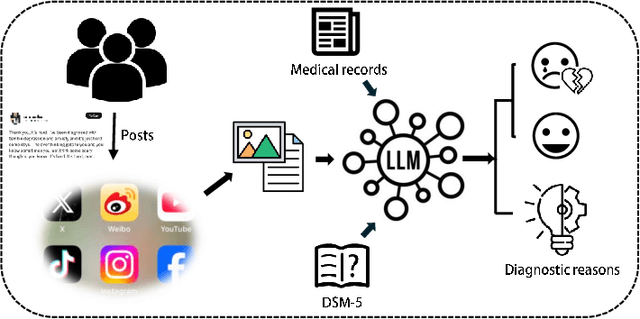
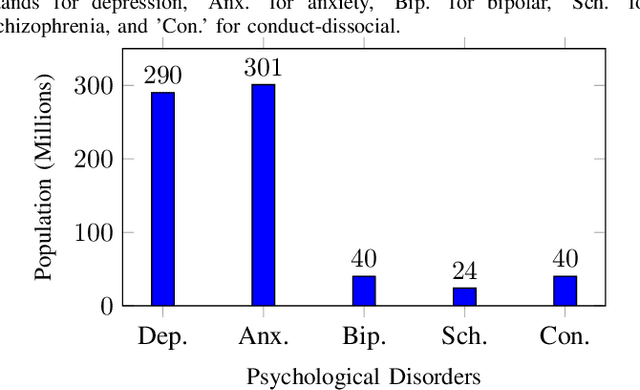
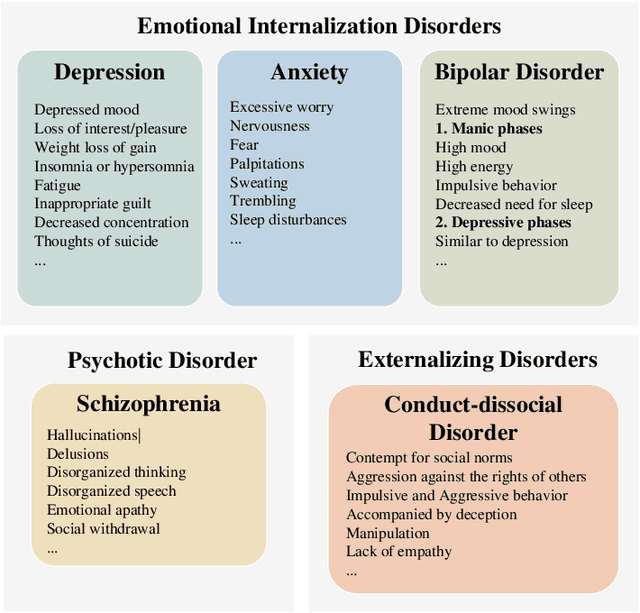
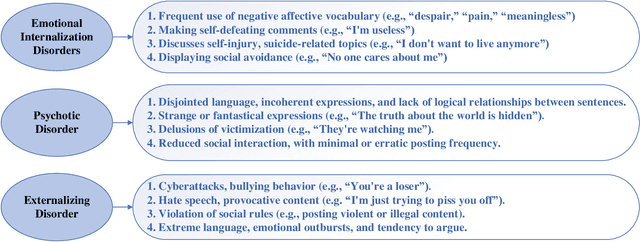
The detection and intervention of mental health issues represent a critical global research focus, and social media data has been recognized as an important resource for mental health research. However, how to utilize Large Language Models (LLMs) for mental health problem detection on social media poses significant challenges. Hence, this paper aims to explore the potential of LLM applications in social media data analysis, focusing not only on the most common psychological disorders such as depression and anxiety but also incorporating psychotic disorders and externalizing disorders, summarizing the application methods of LLM from different dimensions, such as text data analysis and detection of mental disorders, and revealing the major challenges and shortcomings of current research. In addition, the paper provides an overview of popular datasets, and evaluation metrics. The survey in this paper provides a comprehensive frame of reference for researchers in the field of mental health, while demonstrating the great potential of LLMs in mental health detection to facilitate the further application of LLMs in future mental health interventions.
GKG-LLM: A Unified Framework for Generalized Knowledge Graph Construction
Mar 17, 2025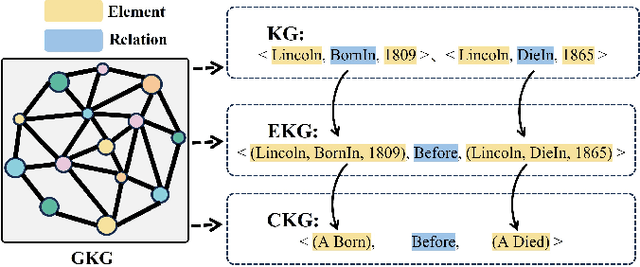
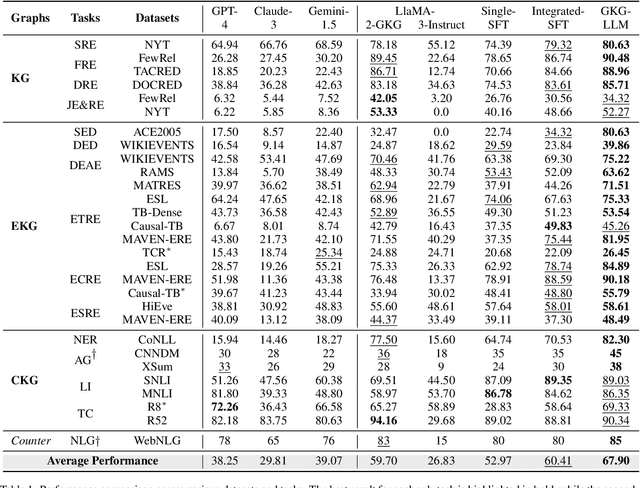
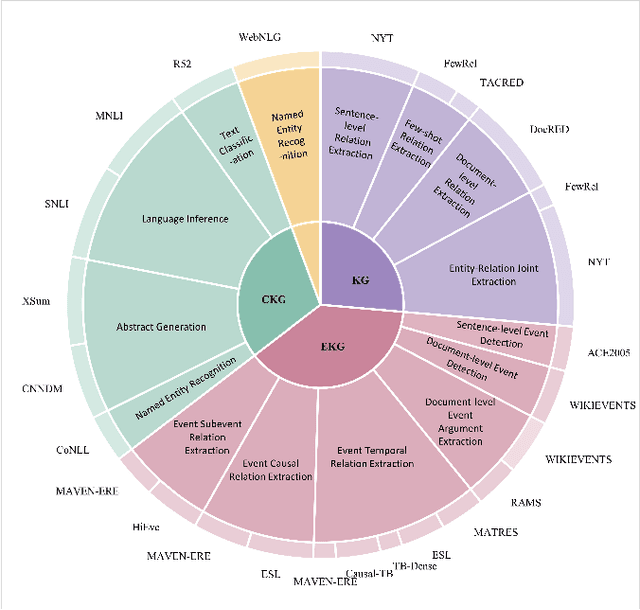
The construction of Generalized Knowledge Graph (GKG), including knowledge graph, event knowledge graph and commonsense knowledge graph, is fundamental for various natural language processing tasks. Current studies typically construct these types of graph separately, overlooking holistic insights and potential unification that could be beneficial in computing resources and usage perspectives. However, a key challenge in developing a unified framework for GKG is obstacles arising from task-specific differences. In this study, we propose a unified framework for constructing generalized knowledge graphs to address this challenge. First, we collect data from 15 sub-tasks in 29 datasets across the three types of graphs, categorizing them into in-sample, counter-task, and out-of-distribution (OOD) data. Then, we propose a three-stage curriculum learning fine-tuning framework, by iteratively injecting knowledge from the three types of graphs into the Large Language Models. Extensive experiments show that our proposed model improves the construction of all three graph types across in-domain, OOD and counter-task data.